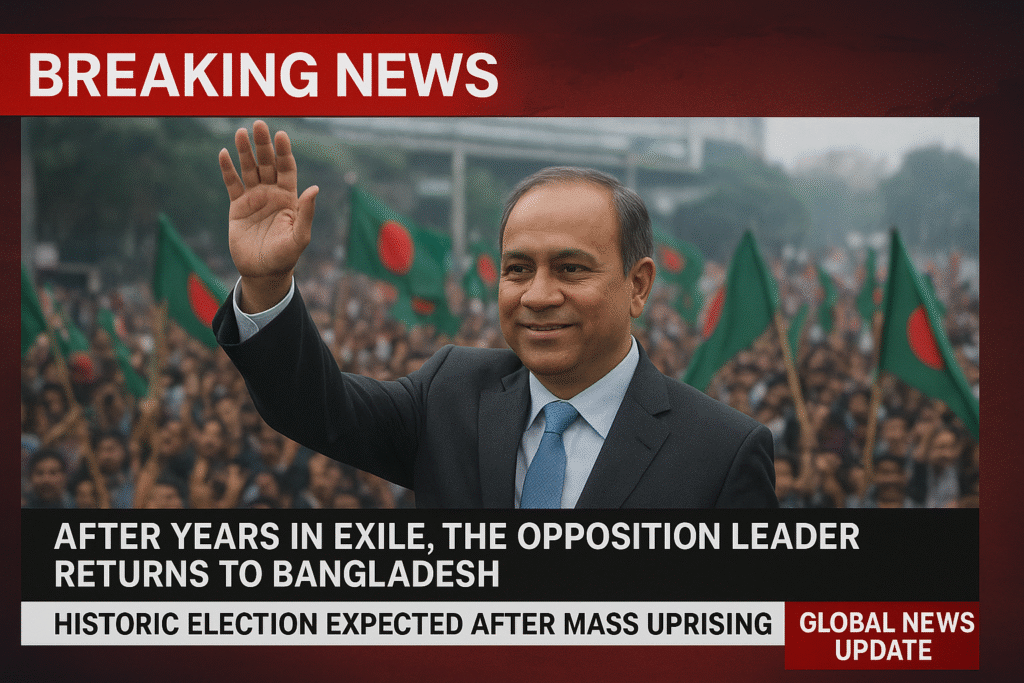
The man predicted to be Bangladesh’s future prime minister has put an end to months of conjecture by declaring that he will return from twenty years abroad to run in historic elections.
“The time has come, God willing, I will return soon,” Tarique Rahman, the acting chairman of the Bangladesh Nationalist Party, said in his first in-person interview with BBC Bangla in almost two decades.
Rahman, the son of the party’s sick leader, is anticipated to govern the nation if the BNP wins the February election, which it is leading.
Following the overthrow of three-time Prime Minister Sheikh Hasina in 2024 due to widespread protests, many consider it to be one of the most significant events in Bangladesh’s history. It seems unlikely that her Awami League party would be permitted to participate.
UN investigators report that as many as 1,400 individuals lost their lives during the 2024 unrest, which involved a lethal response to student-led protests that removed Hasina from power.
Hasina, having escaped to India, is being tried in absentia for alleged crimes against humanity that occurred during the protests.
Since her ousting, many have wondered why Rahman remains in London, where he has resided since 2008.
“Perhaps for some personal reasons, the return has not occurred yet.” “Yet I believe the moment has arrived,” he stated.
“This is an election that people awaited; I cannot stay away during this period.”
The Awami League defeated the BNP, its longstanding adversary, and other challengers over 15 years of governance. Rahman, convicted in several cases in his absence, was exonerated of all accusations following Hasina’s removal.
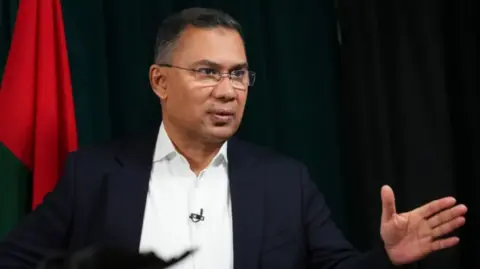
The Awami League has been prohibited from engaging in political activities until the conclusion of the trial of its leaders by the interim administration, which is headed by Nobel winner Prof. Muhammad Yunus. All of the accusations against Hasina and her party are denied.
The BNP seems to agree with the Awami League’s involvement, despite the BNP’s criticism of the interim administration during the previous year for failing to announce an election date.
Tarique Rahman declared, “Those who ordered killing and torture must be brought to justice.”
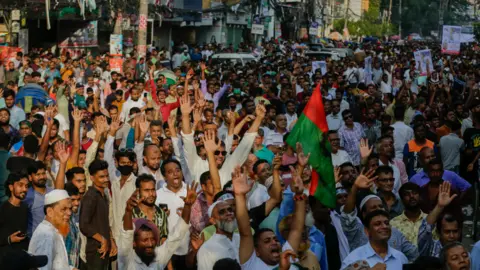
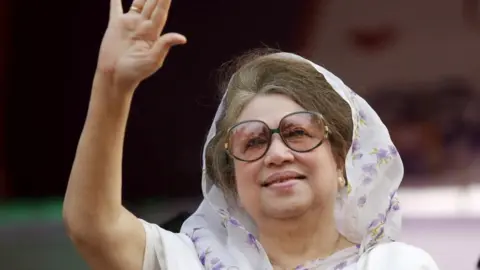
In the absence of its primary competitor, many believe the BNP will secure an easy victory in the election – and if the party triumphs, Rahman, 58, is anticipated to become the next prime minister. His mother, ex-PM Khaleda Zia, aged 80, is unwell and unlikely to engage actively in the campaign.
Nonetheless, Jamaat-e-Islami, the biggest Islamist party in the nation, has apparently made some progress in the past year. Its student faction achieved majorities in two public university student union elections for the first time, invigorating the party.
Rahman believes that the outcomes of the student union will not affect the general election. Their share of votes in past elections was significantly lower than that of the two dominant parties.
Jamaat-e-Islami is currently negotiating with other Islamist political parties to create a coalition, yet Rahman claims he is not concerned about this possibility.
“The BNP encountered rivalry in previous elections.” “There’s no reason for concern,” he stated.
In the early 2000s, the BNP and Jamaat established a coalition government, yet they have lately followed separate directions.
In the meantime, a newly formed party headed by student leaders of the protest, the National Citizen’s Party (NCP), struggled to secure significant backing in the student union elections. For a party led by youth, failing on their own ground has sparked concerns regarding their future in the national election.
Relations with Bangladesh’s biggest neighbor, India, have been strained since Hasina took refuge in Delhi.
Bangladeshi courts have released a warrant for her capture, and Bangladesh has requested her extradition. India has not officially responded yet.
The connection with India is a delicate matter in Bangladeshi politics. The nation has the largest portion of its land border with India. Political parties, such as the BNP, have repeatedly condemned Delhi for backing the Awami League, particularly regarding the three disputed elections conducted during its governance.
“Should they [India] choose to anger the Bangladeshi people by supporting a dictator, then it is not our concern,” stated Rahman.
A key topic in the election will probably be the commitment to democratic change and freedom of expression. The Awami League government faced significant criticism for stifling opposition, which included a court ruling prohibiting the media from reporting on Tarique Rahman’s speeches.
He informed the BBC that he would guarantee such limitations do not occur again if he gains power.
The temporary government is working to reach an agreement among political factions on a series of reforms, yet advancement has been gradual. For a significant number of Bangladeshis, especially the youth who spearheaded last year’s protests, safeguarding fundamental liberties will be a crucial challenge for the upcoming government.