
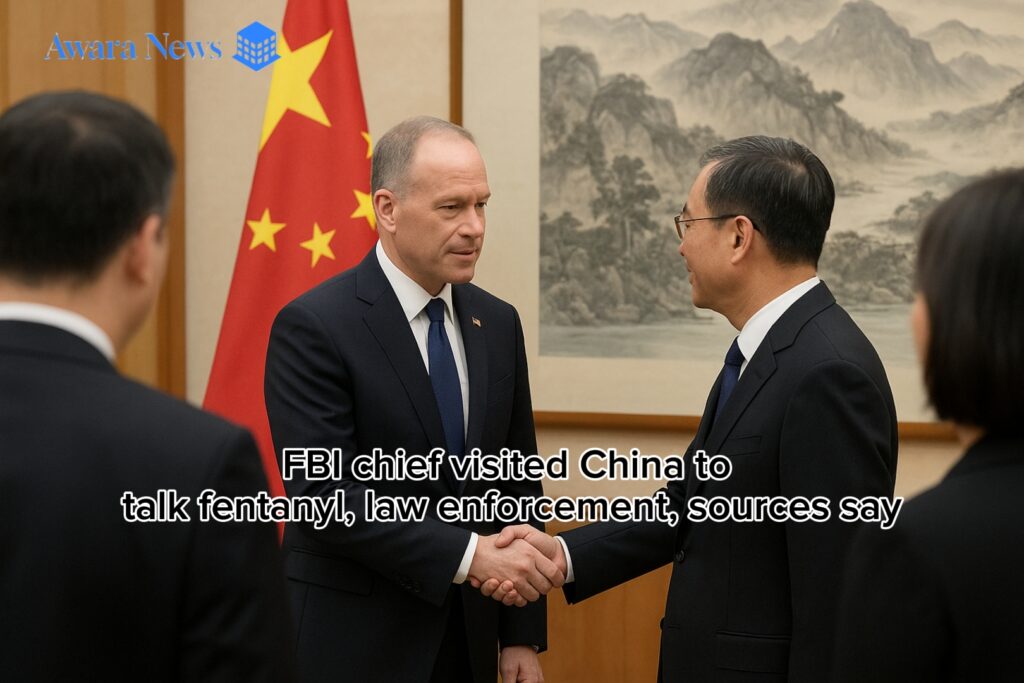

FBI Director Kash Patel traveled to China last week to address fentanyl and law enforcement matters, according to two individuals acquainted with his visit, after a summit between the presidents of the United States and China, where they both praised a “consensus” on the issue.
An individual informed about Patel’s visit mentioned that the FBI director arrived in Beijing on Friday (local time) and remained for approximately one day. He engaged in discussions with Chinese officials on Saturday, the individual mentioned.
Patel’s trip to Beijing wasn’t publicly disclosed by the US or China and is being reported by Reuters for the first time.
Chinese foreign ministry spokesperson Lin Jian stated on Monday that he did not have knowledge of the trip. China’s Ministry of Public Security and the US embassy in Beijing did not reply to requests for comment.
On Monday, China’s Commerce Ministry stated that the nation will modify the list of precursor chemicals related to drugs and will mandate licenses for exporting specific chemicals to the United States, Canada, and Mexico.
US President Donald Trump reduced the tariffs on Chinese products imposed as a consequence of the fentanyl trade to 10 percent after securing an agreement during last month’s discussions with Chinese leader Xi Jinping.
Trump informed reporters following the discussions that Xi will strive “very hard to halt the flow” of fentanyl, a lethal synthetic opioid that is the primary cause of overdose fatalities in the U.S.
US Treasury Secretary Scott Bessent stated that the specifics of the new agreement would be finalized through a newly established bilateral working group. It was uncertain if Patel addressed the new mechanism while in Beijing.
For Trump officials, who had maintained that punitive measures would not be lifted unless China demonstrated that it was taking action against fentanyl supply chains, the agreement represented a change.
Chinese authorities fiercely defend their record on fentanyl, claiming that they have already taken significant steps to control the precursor chemicals used in the drug’s production and accusing Washington of exploiting the problem as “blackmail.”
Beyond fentanyl, the Xi-Trump agreement called for China to resume buying US soybeans.
Beijing, for its part, consented to postpone export restrictions on rare earths, which are essential components of many contemporary technologies, that were announced in October.