
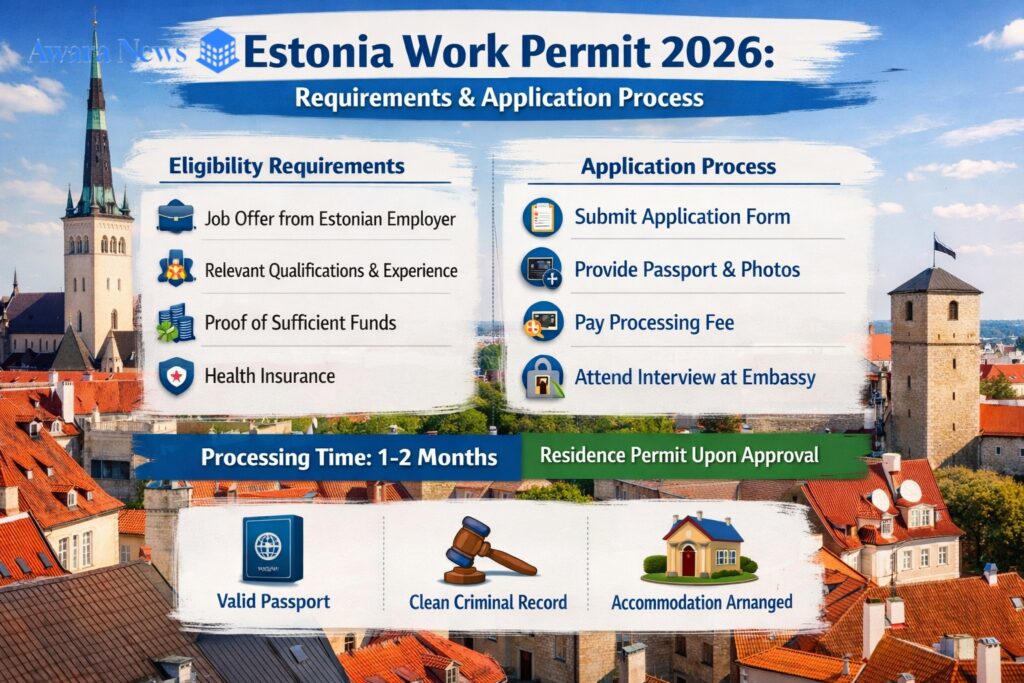
Estonia Work Permit 2026: An Overview
Estonia, a digitally advanced EU and Schengen member state, attracts global talent — particularly in IT, engineering, healthcare, and other specialized sectors. Non-EU citizens who want to work in Estonia generally need either a temporary residence permit for employment, an EU Blue Card, or a short-term employment registration depending on the type and duration of work.
Recent legislative amendments that came into effect on 1 January 2026 have altered employer eligibility requirements and application procedures for foreign workers. These changes aim to strengthen labour market protections, ensure compliance with local laws, and prioritize established businesses.
🧑💼 Types of Work Permits & Work Visas
1. Short-Term Employment Registration
This is the simplest route for non-EU workers who intend to work temporarily (up to 365 days within a 455-day period). Rather than a residence permit, the employer registers the employment with the Police and Border Guard Board.
Key Features:
-
Valid for up to 12 months within a 455-day window.
-
No long-term residence permit needed.
-
Faster processing (registration decision within ~15 working days).
2. Temporary Residence Permit for Employment
If you plan to work in Estonia longer than the short-term period, you must apply for a temporary residence permit for employment. This permit allows you to live and work in Estonia for the duration of the permit (often up to 5 years, renewable).
3. EU Blue Card
For highly skilled workers (e.g., with a bachelor’s degree and/or extensive professional experience), Estonia — like other EU countries — offers an EU Blue Card, which provides greater mobility within the EU. Requirements include:
-
An employment contract of at least 1 year.
-
Salary at least 1.5× Estonia’s average gross salary.
-
Recognized qualifications.
📜 Key Eligibility Requirements
To apply for any work permit in Estonia in 2026, you typically must meet the following core eligibility criteria:
✔ Valid Job Offer / Employment Contract
You must have an employment contract or written confirmation from an Estonian employer. Without this, you cannot start the permit process.
✔ Employer Requirements (New 2026 Rules)
Starting 1 January 2026, employers hiring foreign workers under both short-term registration and temporary residence permits must:
-
Be registered in the Estonian Business Register.
-
For residence permit applications, prove at least six consecutive months of actual economic activity in Estonia (or in the EEA for temporary agency work).
Exceptions: This activity requirement does not apply for posted workers, teachers, researchers, or certain public sector roles.
✔ Professional Qualifications
Your education, experience, and skills must match the job requirements. Degrees and diplomas may need validation for regulated professions.
✔ Remuneration
For short-term employment registration, the employer must pay at least Estonia’s average gross monthly salary published by Statistics Estonia.
✔ Health Insurance
You must have health insurance coverage for your stay in Estonia.
✔ Clean Criminal Record
Most permit types require a police clearance certificate or background check.
✔ Proof of Accommodation & Financial Means
You might need to show you have a place to live in Estonia and sufficient funds to support yourself.
🗂️ Step-by-Step Application Process
Here’s a detailed breakdown of how to apply for an Estonian work permit in 2026:
Step 1: Secure a Job Offer
Before anything else, obtain a valid employment contract from an Estonian employer. This contract is essential for both short-term registrations and residence permits.
Step 2: Employer Pre-Application Tasks
For residence permit applications, the employer must:
-
Register the job with the Unemployment Insurance Fund to justify hiring a foreign worker if local candidates are not available.
Step 3: Prepare Your Documents
Common documents include:
-
Valid passport (with blank pages)
-
Employment contract
-
Educational certificates & CV
-
Health insurance proof
-
Clean criminal record
-
Biometric photos
-
Proof of accommodation
Ensure all documents are accurate, authenticated, and translated if required.
Step 4: Submit the Application
You can submit your application:
-
At an Estonian embassy or consulate abroad (standard route), or
-
• Directly to the Police and Border Guard Board in Estonia if you are already legally present.
Step 5: Biometrics
Most applicants must provide biometrics (fingerprints and photo) during the visa/residence permit process.
Step 6: Wait for Processing
Processing times vary:
-
Short-term employment registration: decisions often within 15 working days.
-
Residence permits: generally 1–3 months or longer.
Step 7: Internal Registration in Estonia
Once approved:
-
Register your place of residence in the Population Register within one month of arrival.
⏱️ Processing Times & Validity
| Permit Type | Typical Validity | Processing Time |
|---|---|---|
| Short-Term Employment Registration | Up to 12 months within 455-day period | ~15 working days |
| Temporary Residence Permit for Work | Up to 5 years (renewable) | ~1–3 months |
| EU Blue Card | 1–2 years (renewable) | ~1–3 months |
👨👩👧 Family Reunification
If your work permit is approved (e.g., temporary residence permit or EU Blue Card), you can usually bring your spouse and minor children. They will need to apply for accompanying residence permits and meet certain requirements (income, accommodation, health insurance).
❗ Common Reasons for Rejection
Work permit applications may be denied for reasons such as:
-
Incomplete or incorrect documents
-
Employer not meeting the economic activity requirement
-
Job not matching qualifications
-
Criminal record or health issues
-
No proof of sufficient income or accommodation
💡 Tips for a Successful Application
✔ Start Early: Embassy appointments and processing times can be unpredictable.
✔ Double-Check Documents: Errors are a common reason for delays or refusals.
✔ Verify Employer Compliance: Ensure your employer meets the new 2026 business activity and registration rules.
✔ Consult Experts: Lawyers or immigration professionals can help navigate complex cases.
🧠 Final Notes
Estonia’s 2026 work permit framework balances access to foreign talent with labour market protection and legal compliance. New requirements — particularly the employer business activity proof — aim to support stable employment practices and reduce administrative gaps.
While short-term employment registrations remain relatively accessible, long-term residence permits require careful planning, documentation, and an understanding of both employer and employee responsibilities.