
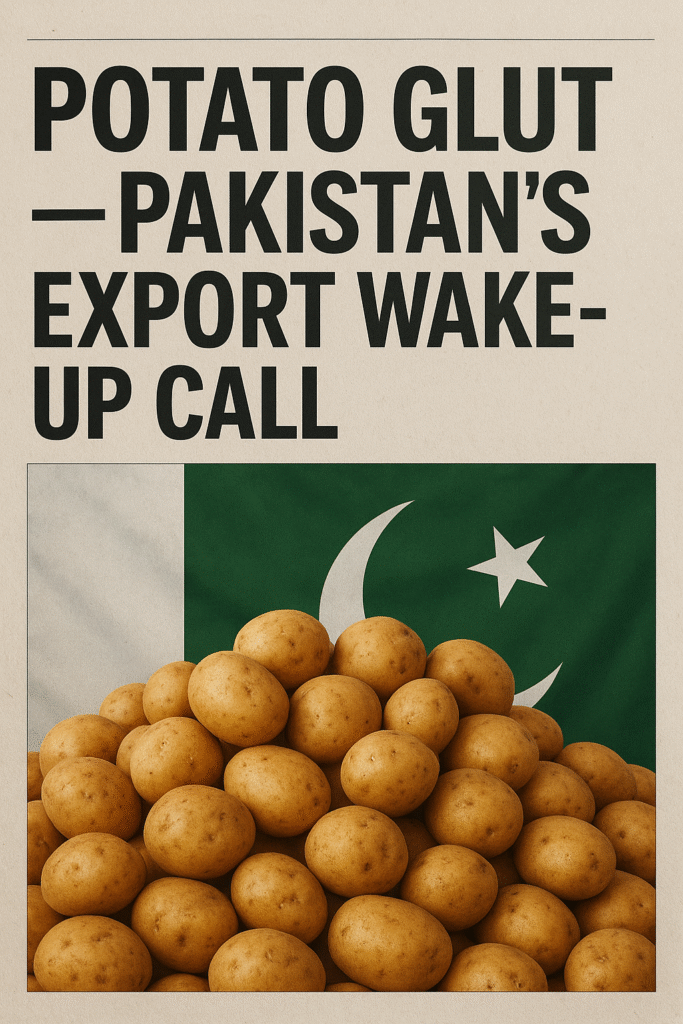
A increasing supply glut caused Pakistan’s potato market to plummet last week. The previous crop — held for both exports and domestic consumption — is currently being offloaded at vegetable markets by farmers and stockists at prices that do not even cover shipping costs and cold storage rent.
The new potato harvest — primarily from Khyber Pakhtunkhwa and Punjab’s Soon Valley — has now arrived in the market but is selling for almost half of last year’s prices.
The cause is evident: the sealing of the Afghan border in October has stopped not just direct exports to Afghanistan but also the crucial transit trade to Central Asian nations and Russia. Afghanistan has traditionally been the biggest potato market for Pakistan. In 2023, Pakistan shipped 755,811 tonnes of potatoes valued at $140 million, with 311,798 tonnes (41 percent) sent to Afghanistan. Similarly, in 2024, exports reached 736,062 tonnes worth $138 million, with Afghanistan once more representing approximately 42% of the volume, based on the Trade Map data from the International Trade Commission.
This significant reliance on one unstable market reveals a persistent structural vulnerability. While nearly all rapidly developing nations have adopted export-oriented growth, Pakistan has maintained an import-based approach for the last 35 years. Consequently, the nation’s overall exports are confined to merely $32 billion in FY25. Significantly, Pakistan’s ratio of exports to GDP has decreased drastically from 17.3% in the early 1990s to 10.4% in 2024 according to the World Bank. This decrease has led to a significant and ongoing trade deficit, which consequently triggered a steep increase in external debt.
The survival of potato farmers hinges critically on the reopening of the Afghan border, since our traditional agriculture sector is ill-equipped to explore new international markets.
These poor economic policies have resulted in Pakistan having a limited variety of exportable goods and markets. In farming, the susceptibility is even more pronounced: consistent exports are restricted to a few essential goods — limited in worth and low in quantity (excluding rice).
Potato — the biggest vegetable in Pakistan by both area and production — produces a significant exportable surplus annually. Nonetheless, the government maintaining that “war and commerce with Afghanistan cannot coexist” has led the sector to confront a critical predicament due to a significant drop in export levels. Although security reasons warrant the closure, the economic repercussions require alternatives.
Initially, redirect exports via Iran to Central Asian countries and Russia; this is theoretically feasible but mainly limited in volume, hindered by global sanctions on Iran and significantly increased freight expenses.
Secondly, investigate new markets, which seems attractive, but our previous results with trade missions provide minimal cause for hope. Creating a foothold in new markets and developing trustworthy business-to-business trade connections requires years. Additionally, nations are progressively strengthening their food safety, sanitary, and phytosanitary regulations, and Pakistan’s conventional agricultural sector, characterized by decreasing farm sizes, is poorly prepared to meet these strict standards.
With potato area and output on the increase — rising 14% and 11.5% respectively for 2024–25, according to the Pakistan Economic Survey FY25 — the surplus available for export is also growing. The existing standing crop (2025-26) covers even greater land area, with a robust harvest anticipated.
However, without feasible opportunities to enter new markets this year, the surplus is likely to recur in 2026, maintaining low prices and further burdening farmers with losses — a significant issue in a nation with poverty rates surpassing 44%. In the current scenario, this year, the survival of potato farmers — farming approximately 1 million acres — depends crucially on the reopening of the Afghan border.
Yet, although the border reopening may provide short-term relief for farmers this year, lasting stability in the sector requires well-designed, strategic interventions from the government.
Initially, shift towards import-replacement strategies in the agricultural industry. Every year, the nation encounters excess production and surpluses in certain crops while dealing with deficits in others — mainly because farmers often change crops depending on the previous season’s earnings instead of a data-informed analysis — a typical bandwagon phenomenon.
To address this imbalance, the government needs to implement policies and incentives that motivate farmers to increase the production of crops like canola, chickpeas (gram), and pulses, which Pakistan imports significantly, resulting in billions in foreign currency expenses.
Numerous crops are currently cultivated in Pakistan on large tracts of land, and the nation’s agro-climatic environment is very conducive. Concurrently, the land devoted to surplus crops that cannot be exported — such as potatoes (following the closure of the Afghan border) — ought to be slowly decreased. If not, farmers will keep facing losses from persistent oversupply, and the nation’s GDP growth will stay constrained.
Secondly, encourage contract farming based on clusters, where associations of exporters collaborate directly with farmers to cultivate crops—like potatoes—that align with the requirements of particular export markets.
Third, value addition — especially for perishable products — must be prioritised to absorb surplus, limit post-harvest losses, and provide employment. Many value-addition enterprises were previously unfeasible due to high electricity prices, but the widespread use of solar power has now made many ventures financially possible.